Reflections and Resources for Lifelong Learning for Missionaries

Category: Book Reviews Page 3 of 17

Working Genius
Photo by MART PRODUCTION

What is your genius at work?

I have taken many different personality and strength assessments over the years. Myers-Briggs, Grip-Birkman, MinistryStyles, StrengthsFinder, DiSC, Enneagram, and 5 Voices are a few that stick out. Part of my motivation in taking these assessments was to evaluate their effectiveness. I wanted to see how well they helped team members understand one another better. Would they help us in our training of new cross-cultural workers? But I have to admit a big part of my motivation was just my innate curiosity to understand myself better.

Shortcomings of personality assessments

Each of these assessments has their strengths. I have learned something from each of them about how I am wired. They have helped me to understand the challenges I face in working with colleagues of different personalities.

But none of the ones above helped me understand what specific personalities / strengths are needed on a team. How do the different personalities work together to accomplish the work of innovating, developing, launching and finishing a project? None of them helped me clearly identify what parts of a project I personally would find most frustrating and what type of tasks I would find most fulfilling.

Missions Disrupted – Some more questions

A review of “Missions Disrupted” – Part 2

missional professionals

In my previous blog post, I began a review of Larry Sharp’s new book, Missions Disrupted: From Professional Missionaries to Missional Professionals. I noted that while I agree with much of what the book is saying about missions, I do have a few questions and cautions. In this post, I will continue to explain my concerns.

Negative view of church planting

I am mystified by Sharp’s apparent dislike of church planting.

However, if one looks at mission as being God’s endeavor, we will see ourselves as going with him into the world. It is first and foremost his work to make disciples, rather than the ecclesiastical framework of today’s missionary efforts, which focus on getting people into the church and on church planting, the mantra of nearly every missionary agency today. From the viewpoint of the rest of the world, this is proselytism and conversion and hardly what the term missio Dei has in mind.

Missions Disrupted, pp. 27-28.

As in the case of the “missionary” terminology, maybe Sharp is more concerned with the words we use than with the work of starting new churches.

Long-time mission agency leader and president of Peace Catalyst International, Rick Love, prefers to use the term “gospel planting” as more biblically accurate. He asserts that nowhere does the New Testament imply that we are to plant a church. He suggests that the term “church planting” implies that we bring the church from the outside.

Missions Disrupted, p. 34.

Nevertheless, in one of many examples of BAM in the center of the book, he notes that church planting occurred as a result of the business enterprise. But he is quick to clarify that this did not happen because the practitioners had a “church planting strategy”.1 (p. 106).

Is the era of professional missionaries over?

A review of “Missions Disrupted” – Part 1

Larry Sharp definitely knows the mission world. He served with Crossworld (then Unevangelized Fields Mission) in Brazil for over two decades. In 1993, he returned to the USA and became the Vice President for the mission in the home office. He is now Vice President Emeritus and serves as a business consultant for Crossworld. Prior to leaving his executive role with the mission agency, he founded IBEC Ventures. This organization focuses on serving missional professionals who want to engage in Business as Mission. He continues in a training role with IBEC to this day. I have met Larry in intermission gatherings and have known his siblings since my college days. So, when I heard that this seasoned missionary leader had written a book on the demise of the missions movement, I wanted to know what he had to say.

Many great BAM examples

missional professionals

The book is entitled “Missions Disrupted: From Professional Missionaries to Missional Professionals“. It focuses on how business professionals can extend the kingdom God in the world of business. In this valuable resource, Sharp gives us multiple succinct examples of missional business ventures. These ventures have proven effective in making disciples of the nations while at the same time addressing significant material needs in their local communities. I count 27 such case studies. They tell the stories of business professionals who have decided to use their skills to bless the nations. They are truly inspiring examples of both large-scale and small-to-medium-scale business start-ups, all with the goal of living out the Gospel in cross-cultural contexts.

models of evangelism

Models of Evangelism

I needed a different model

I have never seen myself as an evangelist. Maybe that is a strange admission for someone who has been a cross-cultural missionary for more than 35 years. I enjoyed leading evangelistic Bible studies when I was a church planter in the Philippines. I found great delight in crafting and sharing a brief Gospel message at the end of each of our TESOL nights at the Central Baptist Church in Kyiv a few years ago. But just walking up to random strangers and initiating conversations about the Gospel has never fitted my personality. Nor did it seem particularly effective. My own distrust and avoidance of salesmen is probably part of the problem here. I would prefer a different model of evangelism.

My problem was further compounded by the amount of time I devote to interacting with other cross-cultural workers. The longer I have been in mission leadership roles, the fewer opportunities I have had to share the Gospel with those I meet on an ongoing basis. I needed a model that fit the new realities in my mission assignment.

As the years passed, my guilt due to my lack of evangelistic involvement prompted me to look for a different way of evangelizing. I thought maybe I should find a model that would play to my strengths in technology. I think I can also say that this was the leading of the Spirit.

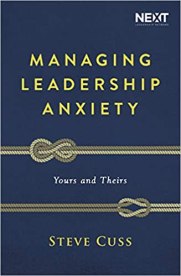
Managing Leadership Anxiety
Photo by Andrea Piacquadio

Managing Leadership Anxiety: a review

I would not have readily chosen “anxiety” as the word to characterize my low experiences in leadership. Frustration, yes. Loneliness, yes. Overwhelmed, yes. Disappointment, yes. But I have not often thought of myself as suffering with anxiety. That is, I had not identified my struggles in leadership as anxiety until I read (listened to) Steve Cuss’ book, Managing Leadership Anxiety: Yours and Theirs. I now realize that anxiety has often been at the root of many of these struggles.

In this blog post, I want to continue the theme of the last couple of blog posts – reviewing helpful books on leadership. As was true of both previous blog posts, these books are not only for those in formal leadership roles. All of us in cross-cultural missions are leaders if we are seeking to lead people to change their thinking, beliefs and lifestyle. “Managing Leadership Anxiety” therefore applies to all of us who sense a call to disciple the nations to become followers of Jesus.

Leaders need to manage their own anxiety first

Besides being an author, Steve Cuss is a pastor who began his ministry as a trauma and hospice chaplain. In helping families deal with grief and loss, he learned that he needed to first of all manage his own anxiety. He needed to understand what was going inside of himself before he could truly connect with others. When he became a lead pastor of a rapidly growing church, he realized that anxiety came with that role as well. Cuss needed to develop ways of thinking and behaving that allowed him to manage that anxiety.

The goal of managing anxiety is not simply for relief, it is to connect more fully with God and to raise awareness of what God is doing. Anxiety blocks our awareness of God because it takes our subconscious attention. This means that anxiety can be an early detection system that we’re depending on something other than God for our well-being.

Cuss, Steve. Managing Leadership Anxiety (p. 17).

Not knowing what to do

Cuss defines leadership as knowing what to do. But as leaders, we often don’t know what to do. Yet we have to do something, because we are leaders. This makes us very uncomfortable and leads to anxiety. We worry because we can’t control what is going to happen. We are not sure that we have adequate information, wisdom, or training to tackle the task before us. As leaders, we wish that someone would tell us what to do or that we could be certain of a particular outcome. As Cuss says:

Page 3 of 17

Powered by WordPress & Theme by Anders Norén