
Category: Leadership Page 1 of 10

Self-Theologizing and Church Maturity
A recent blog post highlighted three books written by Christian Ukrainian authors and scholars. In my view, this points to an often-overlooked fourth metric for church maturity.
Most church planters are familiar with the traditional criteria for church maturity or an exit strategy. We often look for churches that demonstrate the three “selves”: self-governing, self-supporting, and self-propagating.
These three “selves” do not always develop in a linear way. From my observation, Ukrainian churches have shown a strong vision and trajectory for self-propagation. Their progress toward self-sustainability (self-supporting), however, has been less consistent. At times, churches have looked too quickly to the West for financial support. This is simply my perspective.
The Ukrainian Church as a Sending Church
By 2022, the Ukrainian church was not only self-propagating. In practice, it had also become a sending church. Ukrainian missionaries were already serving among some unreached people groups.
The… Read the whole post

In August 2025, I attended the Global Leadership Summit and heard Juliet Funt speak about what she calls “leadership gluttony.” Although I had never heard of Funt before, her session became my favourite of the entire event. I have since listened to Juliet Funt’s book, A Minute to Think. Her GLS talk focused on one chapter of that book, Chapter 5, titled “The Simplification Questions: Reclaiming the Best by Removing the Rest.“
Funt’s message struck a chord—especially as I think of what is next for SEND International. We’ve recently experienced a leadership transition in several key roles, and new leaders bring fresh energy and ideas. While these new directions inspire hope, Funt urges us to pause and ask: What can we remove from the old to make space for the new?
Her book calls us to reclaim space in our lives, ministries, and leadership. It’s not a plea… Read the whole post

Amanda Benson
Serving at Faith Academy in Manila, Philippines.
The following article comes from the May 2025 newsletter of Amanda Benson, a SEND missionary to the Philippines. Amanda has been a teacher at Faith Academy near Metro Manila. She is now being asked to transition into a leadership role as principal of the middle school. The article is used with permission of the author.
The Doubt Creeps In
A couple of weeks ago, I met with my principal from Faith Academy for a transition meeting. We’ve been meeting regularly for a little while now, but this meeting was specifically to plan for a six-hour leadership team planning meeting that we were going to lead. We ended up talking for over four hours, and as time went by, I started asking myself this question: Can I really do this?
A few days later, we had our planning meeting. The principal and I both led different parts of the meeting. It… Read the whole post

Photo by Andrea Piacquadio
I would not have readily chosen “anxiety” as the word to characterize my low experiences in leadership. Frustration, yes. Loneliness, yes. Overwhelmed, yes. Disappointment, yes. But I have not often thought of myself as suffering with anxiety. That is, I had not identified my struggles in leadership as anxiety until I read (listened to) Steve Cuss’ book, Managing Leadership Anxiety: Yours and Theirs. I now realize that anxiety has often been at the root of many of these struggles.
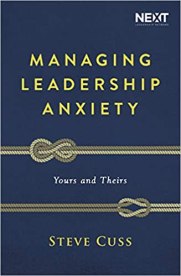
In this blog post, I want to continue the theme of the last couple of blog posts – reviewing helpful books on leadership. As was true of both previous blog posts, these books are not only for those in formal leadership roles. All of us in cross-cultural missions are leaders if we are seeking to lead people to change their thinking, beliefs and lifestyle. “Managing Leadership Anxiety” therefore applies to all of us who sense a call to disciple the nations to become followers of Jesus.
Leaders need to manage their own anxiety first
Besides being an author, Steve Cuss is a pastor who began his ministry as a trauma and hospice chaplain. In helping families deal with grief and loss, he learned that he needed to first of all manage his own anxiety. He needed to understand what was going inside of himself before he could truly connect with others. When he became a lead pastor of a rapidly growing church, he realized that anxiety came with that role as well. Cuss needed to develop ways of thinking and behaving that allowed him to manage that anxiety.
The goal of managing anxiety is not simply for relief, it is to connect more fully with God and to raise awareness of what God is doing. Anxiety blocks our awareness of God because it takes our subconscious attention. This means that anxiety can be an early detection system that we’re depending on something other than God for our well-being.
Cuss, Steve. Managing Leadership Anxiety (p. 17).
Not knowing what to do
Cuss defines leadership as knowing what to do. But as leaders, we often don’t know what to do. Yet we have to do something, because we are leaders. This makes us very uncomfortable and leads to anxiety. We worry because we can’t control what is going to happen. We are not sure that we have adequate information, wisdom, or training to tackle the task before us. As leaders, we wish that someone would tell us what to do or that we could be certain of a particular outcome. As Cuss says:

Is leadership harder today that it was in the past? I think so. A few weeks ago, I led a leadership training for four new field leaders. As I surveyed the challenges they face and the expectations we have today of our field leaders, I noted that what they are being asked to do is significantly more difficult now than it has been in the past.
Technology raises expectations of leadership
Yes, today leaders have a host of technological tools available to help them communicate and organize and collaborate. But those same tools have also raised expectations of them. Those expectations are about how quickly and creatively they will communicate, how neatly and completely they will organize their work, and how broadly and fully they were collaborate with others. Ironically, that which should make leadership easier has also made it more challenging. This is a paradox of leadership today.
When I first took on a major field leadership role more than 30 years ago, I had neither email, Microsoft Teams nor even a cell phone for communication purposes. I did not even have a landline in my home. In some senses, maybe this should should have made leadership more difficult. But no one expected quick responses, regular check-ins or even monthly communication from me. Most of our decisions were made after months of deliberation and extensive discussion with several other mission leaders. The sending offices back in North America had no expectations that I would be involved in communicating with or facilitating vision trips for new missionary candidates before they arrived. It is hard to even imagine such limited communication from a mission leader today.

The demands of leadership today
Tim Elmore, author and founder / CEO of Growing Leaders, very much agrees that leadership is more difficult today than in the past. In his latest book, The Eight Paradoxes of Great Leadership: Embracing the Conflicting Demands of Today’s Workplace, he describes why great leadership today is so demanding. The book was published in November 2021. So, it was written in the context of the COVID-19 pandemic.
COVID has definitely added to the challenges that mission leaders face today. But the challenges of leadership today are not only due to the pandemic.
Leadership is seldom easy, but today it affords us the challenge of collaborating with a more educated, more entitled, more savvy population that has greater expectations of satisfaction and rewards than in past generations. Uncommon leaders stand out because they are able to juggle seemingly contradictory traits to lead such people.
Elmore, Tim. The Eight Paradoxes of Great Leadership (pp. 9-10).