Reflections and Resources for Lifelong Learning for Missionaries

Author: Ken Guenther Page 7 of 42

Director of SEND U

models of evangelism

Models of Evangelism

I needed a different model

I have never seen myself as an evangelist. Maybe that is a strange admission for someone who has been a cross-cultural missionary for more than 35 years. I enjoyed leading evangelistic Bible studies when I was a church planter in the Philippines. I found great delight in crafting and sharing a brief Gospel message at the end of each of our TESOL nights at the Central Baptist Church in Kyiv a few years ago. But just walking up to random strangers and initiating conversations about the Gospel has never fitted my personality. Nor did it seem particularly effective. My own distrust and avoidance of salesmen is probably part of the problem here. I would prefer a different model of evangelism.

My problem was further compounded by the amount of time I devote to interacting with other cross-cultural workers. The longer I have been in mission leadership roles, the fewer opportunities I have had to share the Gospel with those I meet on an ongoing basis. I needed a model that fit the new realities in my mission assignment.

As the years passed, my guilt due to my lack of evangelistic involvement prompted me to look for a different way of evangelizing. I thought maybe I should find a model that would play to my strengths in technology. I think I can also say that this was the leading of the Spirit.

staying on top of things
Photo by Claudio Schwarz on Unsplash

Staying on top of things

A few years ago, I was planning for an upcoming “boot camp” for new field leaders. Our boot camps are two full days of training but hardly “a place or undertaking that resembles a military boot camp especially by requiring one to endure intensive training or initiation”.1 Merriam Webster definition #3 for “boot camp. But then maybe we should ask the participants, not the trainer! In preparation, I asked these new field leaders and their directors what topics they would want us to cover. I gave them a list of topics we had covered in previous years. Someone suggested “how to stay on top of things”, something not on my list. In subsequent years, participants have almost always selected this topic as something they want to address at boot camp.

The difficulty of staying on top of things

This suggestion initially surprised me, but it immediately made sense. New field leaders have a steep learning curve as they move from front-line ministry into more administrative roles in missions. One of the challenges in this transition is how to manage the myriad of expectations, tasks and messages that come with their new role. See my recent blog post on the paradoxes of leadership. But regardless of whether you find yourself in a new leadership role or not, we all struggle to “stay on top of things”. As mission workers, we all end up wearing multiple hats, filling many different roles because of a shortage of personnel.

In this blog post, I want to briefly summarize what we talk about in this hour and a half session at boot camp. These are the principles and tools that have been most helpful for me to “stay on top of things”. I recognize that you will need to adjust my system to fit your personality and work style.

Managing Leadership Anxiety
Photo by Andrea Piacquadio

Managing Leadership Anxiety: a review

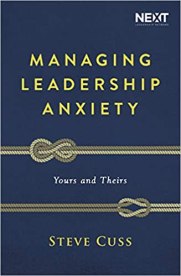
I would not have readily chosen “anxiety” as the word to characterize my low experiences in leadership. Frustration, yes. Loneliness, yes. Overwhelmed, yes. Disappointment, yes. But I have not often thought of myself as suffering with anxiety. That is, I had not identified my struggles in leadership as anxiety until I read (listened to) Steve Cuss’ book, Managing Leadership Anxiety: Yours and Theirs. I now realize that anxiety has often been at the root of many of these struggles.

In this blog post, I want to continue the theme of the last couple of blog posts – reviewing helpful books on leadership. As was true of both previous blog posts, these books are not only for those in formal leadership roles. All of us in cross-cultural missions are leaders if we are seeking to lead people to change their thinking, beliefs and lifestyle. “Managing Leadership Anxiety” therefore applies to all of us who sense a call to disciple the nations to become followers of Jesus.

Leaders need to manage their own anxiety first

Besides being an author, Steve Cuss is a pastor who began his ministry as a trauma and hospice chaplain. In helping families deal with grief and loss, he learned that he needed to first of all manage his own anxiety. He needed to understand what was going inside of himself before he could truly connect with others. When he became a lead pastor of a rapidly growing church, he realized that anxiety came with that role as well. Cuss needed to develop ways of thinking and behaving that allowed him to manage that anxiety.

The goal of managing anxiety is not simply for relief, it is to connect more fully with God and to raise awareness of what God is doing. Anxiety blocks our awareness of God because it takes our subconscious attention. This means that anxiety can be an early detection system that we’re depending on something other than God for our well-being.

Cuss, Steve. Managing Leadership Anxiety (p. 17).

Not knowing what to do

Cuss defines leadership as knowing what to do. But as leaders, we often don’t know what to do. Yet we have to do something, because we are leaders. This makes us very uncomfortable and leads to anxiety. We worry because we can’t control what is going to happen. We are not sure that we have adequate information, wisdom, or training to tackle the task before us. As leaders, we wish that someone would tell us what to do or that we could be certain of a particular outcome. As Cuss says:

leadership paradoxes

The paradoxes of leadership

Is leadership harder today that it was in the past? I think so. A few weeks ago, I led a leadership training for four new field leaders. As I surveyed the challenges they face and the expectations we have today of our field leaders, I noted that what they are being asked to do is significantly more difficult now than it has been in the past.

Technology raises expectations of leadership

Yes, today leaders have a host of technological tools available to help them communicate and organize and collaborate. But those same tools have also raised expectations of them. Those expectations are about how quickly and creatively they will communicate, how neatly and completely they will organize their work, and how broadly and fully they were collaborate with others. Ironically, that which should make leadership easier has also made it more challenging. This is a paradox of leadership today.

When I first took on a major field leadership role more than 30 years ago, I had neither email, Microsoft Teams nor even a cell phone for communication purposes. I did not even have a landline in my home. In some senses, maybe this should should have made leadership more difficult. But no one expected quick responses, regular check-ins or even monthly communication from me. Most of our decisions were made after months of deliberation and extensive discussion with several other mission leaders. The sending offices back in North America had no expectations that I would be involved in communicating with or facilitating vision trips for new missionary candidates before they arrived. It is hard to even imagine such limited communication from a mission leader today.

The demands of leadership today

Tim Elmore, author and founder / CEO of Growing Leaders, very much agrees that leadership is more difficult today than in the past. In his latest book, The Eight Paradoxes of Great Leadership: Embracing the Conflicting Demands of Today’s Workplace, he describes why great leadership today is so demanding. The book was published in November 2021. So, it was written in the context of the COVID-19 pandemic.

COVID has definitely added to the challenges that mission leaders face today. But the challenges of leadership today are not only due to the pandemic.

Leadership is seldom easy, but today it affords us the challenge of collaborating with a more educated, more entitled, more savvy population that has greater expectations of satisfaction and rewards than in past generations. Uncommon leaders stand out because they are able to juggle seemingly contradictory traits to lead such people.

Elmore, Tim. The Eight Paradoxes of Great Leadership (pp. 9-10).
making decisions
Photo by Caleb Jones on Unsplash

Making better decisions

At the end of January earlier this year, my wife and I as well as my colleagues in Ukraine had to make some important decisions. Were we going to stay in Ukraine? Our embassies were warning us about an impending invasion from Russia and encouraging us to leave. If we stayed, what would be sufficient reason to leave in the future? If we left, where would we travel to? Bertha and I had tickets to leave Ukraine on February 20 for some training we had planned many months ago. Should we wait until then or change our travel plans so as to leave earlier?

Missionaries make life-altering decisions

Cross-cultural workers like ourselves have made many life-changing decisions over the course of our missionary career. Our initial decision to join a mission organization had significant and long-lasting consequences for ourselves, our families and our sending church.

The decision we made to transfer from the Philippines to Russia in 1998 was just as major a decision. My wife and I struggled for a couple of years trying to discern whether we should leave the Philippines, when would be the right time to do so, and where we would move to. The decision we finally made meant we were going to have to learn a very different language and culture. Our children’s future education was going to be impacted in a big way since we would not have a MK school in Far East Russia.

Our decision almost 10 years later to accept the invitation to head up our mission’s training department and move to Ukraine had similar far-reaching consequences.

Now we are faced with the decision of where our future ministry will be based, in light of the ongoing conflict in Ukraine.

Page 7 of 42

Powered by WordPress & Theme by Anders Norén